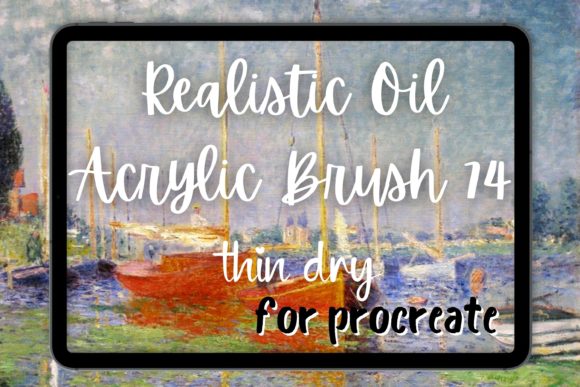
Evaluating Procreate Oil Brush 74 Thin Dry for Digital Impressionism
The transition from traditional media to digital platforms often presents a significant hurdle for artists: the loss of tactile feedback and organic texture. For those seeking to replicate the physical sensation of applying pigment to canvas within the iPad ecosystem, specialized tools are essential. The Procreate Oil Brush 74 Thin Dry emerges as a specific solution designed to bridge this gap. This brush is engineered to simulate the resistance and granular texture of dry oil paint, offering a distinct alternative to the smooth, vector-like strokes common in default digital libraries. Understanding its mechanics, strengths, and limitations is crucial for artists deciding whether it aligns with their workflow.
Understanding the Mechanics of Dry Oil Simulation
At its core, the Procreate Oil Brush 74 Thin Dry is not merely a standard round brush with reduced opacity. It is constructed using data derived from real-life brush strokes, aiming to capture the irregularities that occur when a stiff-bristled brush drags across a textured surface with limited medium. This results in a "broken" stroke effect, where the digital pigment does not cover the canvas uniformly. Instead, it leaves gaps that reveal the underlying layers or canvas texture, mimicking the behavior of thick, viscous oil paint that has begun to set or is applied sparingly.
This characteristic makes it particularly effective for techniques associated with impressionism and abstract painting. Unlike wet brushes that blend colors seamlessly on the canvas, this tool encourages a painterly approach where individual marks remain visible. The "thin" aspect of the brush allows for precise detailing while maintaining the rough, organic edge quality that defines traditional media. For artists familiar with terms like van gogh brush or van gogh oil, this tool attempts to digitize that specific historical aesthetic characterized by visible, expressive impasto.
Key Benefits for Digital Painters
- Authentic Texture: The primary advantage is the immediate generation of complex texture without the need for additional overlay effects or post-processing. The brush engine handles the granulation, allowing artists to focus on form and color rather than manually adding noise.
- Layering Capabilities: Because the brush is "dry," it interacts predictably with underlying layers. Artists can build up depth gradually, similar to glazing in traditional oil painting, without muddying colors excessively.
- Versatility Across Media Styles: While marketed as an oil brush, its dry nature makes it surprisingly effective for simulating other media. It can mimic the chalky resistance of pastels, the opaque coverage of a gouache brush, or the stiff application of an acrylic brush used with heavy body paints.
- Precision and Control: The "thin" profile provides greater control over line weight and detail compared to broader wash brushes, making it suitable for both broad structural strokes and finer detailing in oil brush strokes.
Tradeoffs and Considerations
While the Procreate Oil Brush 74 Thin Dry offers significant aesthetic benefits, it is not a universal replacement for all digital painting needs. Artists must consider several tradeoffs before integrating it into their primary toolkit.
First, the learning curve may be steeper for those accustomed to soft, blending-heavy digital brushes. The dry texture requires a different approach to shading and blending. Instead of relying on the brush to smooth transitions, the artist must use optical mixing—placing distinct colors side by side to create the illusion of gradient. This can be time-consuming and requires a solid understanding of color theory.
Second, performance can vary depending on the canvas size and device capabilities. High-fidelity texture brushes often require more processing power. On older iPad models, using this brush at very large canvas dimensions might introduce slight latency, although this is generally minimal for most modern devices. Additionally, because the brush relies on texture maps, scaling it up significantly beyond its intended size may result in pixelation or a loss of the subtle grain details that make it effective.
Ideal Use Cases
This tool is a strong fit for specific artistic goals. It excels in projects where the visibility of the hand is desired. For instance, creating procreate van gogh style studies benefits immensely from the jagged, rhythmic strokes this brush produces. It is also highly effective for concept art that requires a quick, loose feel, allowing artists to block in shapes with energy rather than precision.
Furthermore, illustrators working in editorial or book publishing who need a painterly look without the overhead of traditional scanning will find this brush efficient. It allows for rapid iteration while maintaining a high-end, traditional aesthetic. When included in a broader procreate bundle, it serves as a critical texturing tool, complementing smoother brushes used for base coats or gradients.
When to Consider Alternatives
There are scenarios where the Procreate Oil Brush 74 Thin Dry may not be the optimal choice. If the goal is hyper-realism with smooth, invisible brushwork, such as in photorealistic portraiture or product rendering, a softer airbrush or a standard round brush with pressure-sensitive opacity would be more appropriate. The inherent grain of the dry brush can interfere with the clean lines required in technical illustration or flat design.
Additionally, artists who prefer a wet-on-wet technique, where colors blend fluidly on the canvas in real-time, might find the dry resistance frustrating. In such cases, a dedicated wet oil brush or a watercolor simulation would better serve the workflow. It is also worth noting that if an artist already possesses a comprehensive library of custom textures, they might achieve similar results by adjusting the grain settings of a standard brush, though this requires more technical setup.
Making the Decision
Choosing the right digital tool depends largely on the desired output and personal working style. The Procreate Oil Brush 74 Thin Dry is best viewed as a specialized instrument rather than a general-purpose solution. It is ideal for artists who value texture, expressiveness, and the aesthetic of traditional impasto. Those interested in impressionism, landscape painting, or expressive figure work will likely find it indispensable.
Before committing, artists should evaluate their current workflow. If you frequently find yourself adding texture overlays in post-production, this brush could streamline your process by generating those textures organically during the painting phase. However, if your work relies on clean vectors or smooth gradients, this tool may see limited use. Ultimately, the Procreate Oil Brush 74 Thin Dry represents a sophisticated option for digital painters seeking to reclaim the tactile imperfections of traditional media, offering a compelling balance between control and organic chaos.